🎄 Blog Series #3 of 5 -Preschool Problem-Solving Through Play- Building and Constructing Toys.
As a speech therapist who works with 3-5 year olds daily, I've discovered something powerful: the toys that work magic in my therapy room are the exact same ones my own family plays with for hours. These five toys aren't just fun—they're developmental powerhouses that build problem-solving skills, language development, and fine motor abilities while your preschooler thinks they're just playing. No batteries, no screens, just proven tools that therapists recommend and kids actually love. Whether you're shopping for birthdays, Christmas, or everyday play, these are the toys worth investing in.
SPEECH AND LANGUAGE THINGS
Brick Language
10/13/20259 min read
The 5 Toys My Speech Therapy Kids (And My Nieces and Nephews) Can't Stop Playing With
This post may contain affiliate links, which means we may receive a commission, at no extra cost to you, if you make a purchase through a link. As an Amazon Associate I earn from qualifying purchases.
You know that feeling when you bring home a "top-rated" toy, and your kid plays with it for exactly 3.7 minutes before going back to the cardboard box it came in? Yeah, me too.
But here's the thing—I'm not just an aunt navigating the toy aisle with nieces and nephews tugging on my sleeve. I'm also a speech therapist who spends my days working with 3-5 year olds, watching what actually captures their attention and supports their development. And let me tell you, after using countless toys in therapy sessions and then bringing the best ones home to my own family, I've discovered something powerful: the toys that work magic in my therapy room are the exact same ones my toddler plays with for hours at home.
These five toys? They're not just parent-approved. They're therapist-tested, child-obsessed, and backed by real developmental benefits I see every single day.
Why a Speech Therapist's Toy Picks Hit Different
Before we dive in, let me give you some context. In my therapy sessions, I need toys that do serious heavy lifting. They need to:
Encourage language naturally without feeling like "work"
Build multiple skills at once (because therapy time is precious)
Keep kids engaged for more than 10 seconds
Grow with the child across developmental stages
Actually transfer to home play (what's the point otherwise?)
These five toys show up in my therapy bag weekly AND in my sister's living room daily. That's how you know they're the real deal.
(Amazon paid links)
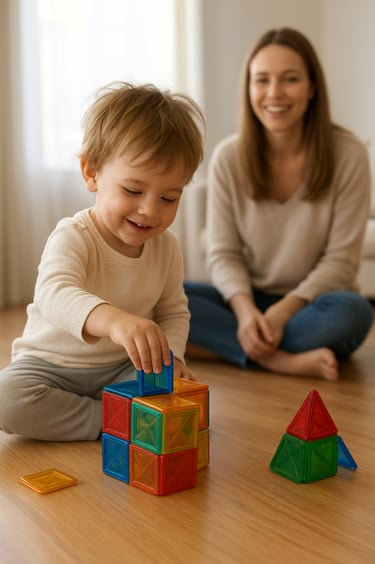
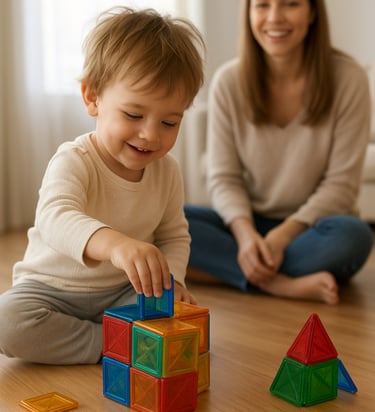
1. MAGNA-TILES Fire Rescue 27-Piece Magnetic Construction Set
Why It's a Therapy Room Staple (And Home Favorite)
I'll never forget the day I brought MAGNA-TILES into a session with a 4-year-old who rarely spoke during play. Within five minutes, he was orchestrating an entire fire rescue mission, complete with siren sounds and detailed buildings that were on "Fire". These tiles? They're language goldmines.
At home, my nephew will build with these for an 30 minutes straight (that's like dog years in toddler time), and I'm not just sitting there timing him—I'm hearing him process, plan, and problem-solve out loud.
What Makes It Special from a Developmental Perspective
The magnetic connection gives instant positive feedback—kids immediately see their ideas take shape, which builds confidence and encourages them to keep creating and narrating their play. The fire rescue theme naturally prompts action words ("rescue," "climb," "spray"), positional language ("on top," "next to," "inside"), and pretend play scenarios that are pure gold for language development.
Therapist insight: I use these to target spatial concepts, probelm-solving, sequencing (first we build the station, then the truck arrives), and cause-and-effect reasoning. The magnets are strong enough that kids don't face constant frustration-induced meltdowns, but they still require enough precision to develop those fine motor skills.
Key Benefits You'll Actually Notice
Problem-solving skills: My therapy kids learn to plan structures verbally before building—a crucial executive function skill
Fine motor skills development: The pinching and precise placement needed develops the hand strength required for pencil grasp
Cognitive development: Understanding magnetic properties and spatial relationships exercises developing brains
Language explosion: The open-ended nature means kids naturally narrate, explain, and describe their creations
Group play: I use these in group therapy sessions because there are enough pieces for parallel play without territory wars
Quick FAQ
What age range is this for?
Officially 3+, and I use them successfully with my entire preschool caseload. Even my cautious 3-year-olds engage confidently because there's no "wrong" way to build.
Are the magnets strong enough for toddlers?
Yes! They're strong enough to stay together during enthusiastic play but not so strong that little hands can't pull them apart. Perfect balance.
Does it include any figures or characters?
The set features firefighter-themed graphics printed on tiles and vehicle shapes. Kids with vivid imaginations will create entire rescue scenarios even without separate figures.
What skills does it help kids develop?
From a therapy perspective: spatial language, action verbs, sequencing skills, categorization, cause and effect understanding, and fine motor precision. It's also fantastic for turn-taking and collaborative play. Plus, it makes a terrific Christmas gift for preschoolers working on any of these skills.
(Amazon paid links)
👉🏽 Check the current price and availability here →
2. Melissa & Doug Blockables™ Vehicles Snap and Play Set
The Language-Building Powerhouse
In my therapy room, I call this the "question generator" because kids naturally start asking and answering questions while they play: "Which wheel should I use?" "What color should the top be?" "How do I make it go faster?" It's not flashy or electronic, but it creates organic opportunities for back-and-forth conversation—which is exactly what we're after.
Why Wooden Blocks Still Win (Especially for Development)
The substantial, tactile nature of wooden toys provides sensory feedback that plastic often doesn't. My sensory-seeking kiddos especially love the weight and sound of these blocks. The mix-and-match design means every child can succeed at their own level—some follow the picture guide exactly, while others create "flying shark cars" that defy all vehicle conventions (and I love it).
Key Benefits from a Therapy Perspective
Categories and grouping: I use these to teach color sorting, vehicle types, and size concepts
Cause and effect: "What happens when we put the biggest block on top?" Great for prediction skills
Problem-solving skills: Figuring out which combinations create functional vehicles exercises logical thinking
Fine motor skills development: The snap-together mechanism is perfect for bilateral coordination—both hands working together
Conversation skills: The building process naturally creates opportunities for commenting, questioning, and requesting
Quick FAQ
Do the blocks come with a storage container?
Yes! The wooden storage tray is a game-changer for therapy and home. My end-of-session cleanup time dropped by about 5 minutes, which is huge.
Are the pieces easy to connect?
They require just the right amount of effort—enough to build finger strength but not so much that kids shut down from frustration. I've watched 3-year-olds master this independently.
What age is this best for?
Ages 3+ is accurate. I use it with my entire preschool population, adjusting expectations based on fine motor development.
This makes a terrific Christmas gift for preschoolers, especially those working on hand strength or conversational turn-taking.
(Amazon paid links)
3. Coogam Snap Together Vehicle Toys for Toddlers
The Confidence Builder
Here's something I've learned in therapy: kids need wins. The Coogam set provides immediate success—pieces twist on easily, vehicles actually roll, and kids can create something functional within minutes. I've used this with kids who were hesitant to try new activities, and the quick success rate drew them right in.
At home, my niece loves that she can completely disassemble and rebuild these without needing me hovering over her. Independence = confidence = more play.
What You're Getting (And Why It Matters)
Multiple vehicles that break down into large, colorful pieces. From a therapy standpoint, this is perfect for teaching part-to-whole relationships ("Look, all these pieces make one truck!"), following multi-step directions, and developing the bilateral coordination needed for twisting motions.
Key Benefits
Fine motor skills: The twisting action is different from pinching or grasping—it's excellent for developing rotation strength in those little wrists
Problem-solving: Figuring out which piece goes where exercises trial-and-error thinking
Cognitive development: Understanding assembly and disassembly teaches reversibility concepts
Language opportunities: Great for naming vehicle parts, colors, and actions ("twist," "pull," "connect")
Group play: Multiple vehicles mean I can work on parallel play skills without resource guarding
Quick FAQ
Does it come with a storage container?
Yes! The carrying case is therapist-approved—I actually bring this to home visits because it contains everything neatly.
Does it require batteries?
Nope! Battery-free means no mid-session meltdowns when something stops working. Pure, simple, hands-on play.
Is this toy easy to assemble?
Very. Even my kids with fine motor delays can manage this with minimal support, which builds their confidence tremendously.
👉🏼 Grab this affordable winner here →
4. LEGO DUPLO Town Caring for Animals at The Farm Building Toys Playset
The Pretend Play Catalyst
Let me tell you about a breakthrough moment: I had a 4-year-old in therapy who spoke mostly in single words. We started using this farm set, and suddenly she was saying, "Cow eat" and "Farmer go." The themed nature of this set gives kids a framework for language—they know what happens on a farm, so they have context for the words they're learning.
At home, this has launched countless imaginative scenarios. My niece has "taught" the farmer to read, built hospitals for sick chickens, and created elaborate bedtime routines for the animals. It's pretend play gold.
Why This Set Specifically Works for Development
DUPLO blocks are perfectly sized for little hands still developing their pincer grasp. The farm theme introduces gentle responsibility concepts and animal care vocabulary. In therapy, I use this to teach verbs (feeding, washing, sleeping), prepositions (in the barn, under the tree), and sequencing (first we feed, then we sleep).
Key Benefits from a Speech Therapist's View
Fine motor skills: Perfect for the 3-5 age range—challenging enough to build strength without causing frustration
Problem-solving skills: "How can we build a fence to keep the pig safe?" exercises planning abilities
Cognitive development: Pretend play scenarios are crucial for developing theory of mind and social understanding
Cause and effect: "If we don't build walls, the animals escape" teaches logical consequences
Language structure: Farm scenarios naturally teach sentence expansion and story grammar
Quick FAQ
What is the recommended age range?
LEGO says 2+, and I've successfully used it in therapy with children as young as 3. It's perfect through age 5 and beyond.
Is this LEGO set good for a 3-year-old?
Absolutely! Three is the sweet spot—they can build independently and really dive into pretend play scenarios.
Is this set good for developing fine motor skills?
Yes! The resistance required to connect and separate DUPLO blocks is exactly what occupational therapists recommend for building hand strength. I often co-treat with OTs using this set.
This makes a terrific Christmas gift for preschoolers, especially those who are animal-lovers or working on expanding their language.
(Amazon paid links)
👉🏽 Check out the farm fun here →
5. Melissa & Doug Pizza Party Wooden Play Food Set
The Social Skills Champion
Confession: when I first became a speech therapist, I underestimated play food. Then I watched a nonverbal 3-year-old start "making me a pizza" using pointing and sounds, which evolved into single words, then phrases. This pizza set has facilitated more communication breakthroughs than I can count.
At home, the pizza set has become our go-to for practicing manners, taking turns, and having actual conversations. Last week, my niece "opened a restaurant," took my order, and talked me through the menu with impressive detail.
What Makes It Magical for Language Development
The back-and-forth nature of restaurant play naturally teaches conversational turn-taking. Kids learn to ask questions ("What toppings do you want?"), make requests ("Can I have a piece?"), and follow directions ("Put the pepperoni on first"). It's incredibly versatile for targeting multiple goals in one activity.
Key Benefits from a Therapy Perspective
Fine motor skills: Placing toppings precisely, using the pizza cutter, and lifting individual slices all develop precision and control
Categories and sorting: "Let's put all the vegetables on one side" teaches classification skills
Problem-solving: Dividing pizza fairly introduces early math concepts and logical thinking
Group play: This is my number-one toy for teaching sharing, negotiating, and collaborative play
Cognitive development: Restaurant role-play teaches sequencing (order, make, serve, eat) and social scripts
Language explosion: I target requesting, labeling, describing, and conversational skills all with this one toy
Quick FAQ
Does it come with a storage box?
Yes! The wooden pizza box is sturdy and perfect for storage. At home, cleanup is actually part of the play ("Let's close up the restaurant!").
Does it include a pizza cutter?
Yes, and kids absolutely love the cutting motion—it's great for bilateral coordination and provides satisfying sensory feedback and of course action word practice!
Does it include a spatula?
Yes! The spatula adds authenticity and gives kids another tool to master. I use it to teach balance & controlled movements.
What age is this best for?
Ages 3+ is perfect. I use it across my entire preschool caseload because it's adaptable to different developmental levels.
This makes a terrific Christmas gift for preschoolers, especially those working on social skills, language expansion, or imaginative play.
👉🏽 Get the pizza party started here →
The Bottom Line: Toys That Work in Therapy AND at Home
Here's what 30+ years as a speech therapist (and 28 years as a aunt) have taught me: the best toys don't need bells, whistles, or batteries. They need to spark imagination, invite communication, and grow with your child.
These five toys have proven themselves in both my professional and personal life. They're not collecting dust. They're not causing screen-time guilt. They're creating language, building skills, and actually being played with—daily.
What They All Have in Common
Each toy delivers on multiple developmental levels:
✅ Develops fine motor skills through purposeful manipulation
✅ Builds problem-solving skills through open-ended exploration
✅ Encourages cognitive development via cause and effect learning
✅ Supports language growth naturally during play
✅ Facilitates group play for social skill development
✅ Works without screens or batteries (parent AND therapist approved)
✅ Makes a terrific Christmas gift for preschoolers working on any developmental area
My Final Therapist Advice
You don't need a playroom overflowing with toys. You need a strategic handful of high-quality options that support your child's development while keeping them genuinely engaged. These five have earned permanent spots in my therapy room AND my living room—and that's the highest praise I can give.
Whether you're shopping for birthdays, holidays, or because your child has suddenly outgrown everything (how?!), these choices will serve your family well. I've seen them work with dozens of kids across different skill levels, backgrounds, and play preferences.
As both a therapist and a aunt, I can tell you: these toys are worth the investment. Click the links throughout this post to check current prices and availability. Your child's development (and your sanity) will thank you. 💙
What toys have been game-changers in your house? I'd especially love to hear from other therapy parents—drop a comment below!
This post may contain affiliate links, which means we may receive a commission, at no extra cost to you, if you make a purchase through a link. As an Amazon Associate I earn from qualifying purchases.